Capability
Swiss-Type CNC Machining in Türkiye
HEPTEKNIK manufactures small-diameter precision turned components using Swiss-type / sliding-head CNC machining in Istanbul, Türkiye. Production covers the Ø1–Ø32 mm diameter range for components up to 300 mm in length.
All parts are manufactured to customer drawings, from prototype and sample quantities through to batch and serial production. Fanuc- and Mitsubishi-controlled machines are used according to part geometry, material and production requirements.

Verified capability
Swiss-Type Machining Capability at a Glance
- Diameter range
- Ø1–Ø32 mm
- Swiss-type CNC machines
- 8
- Component length
- Up to 300 mm
- Live tooling
- Yes
- Sub-spindle capability
- Yes
- Production types
- Prototype to series
- Controls
- Fanuc and Mitsubishi
- Management systems
- ISO 9001 / 14001 / 45001
Values describe HEPTEKNIK's Swiss-type machining capability. Manufacturability for a specific component is confirmed after review of the drawing, material, tolerance requirements and quantity.
Process
What Is Swiss-Type Sliding-Head Machining?
In Swiss-type machining the raw material is fed as bar stock through a guide bushing, so the workpiece is supported very close to the cutting zone. Because the unsupported length stays short, the process suits long, slender and small-diameter components that are difficult to hold on a conventional chuck.
- Bar-fed production from continuous stock
- The workpiece is supported close to the cutting zone
- Suitable for long, slender and small-diameter components
- Turning, drilling and milling operations can be combined efficiently during the machining sequence
- Final suitability is confirmed per part: it depends on the drawing, the material and the required quantity

Component types
Components Suitable for Swiss-Type Machining
Swiss-type machining is particularly suitable for small-diameter and long or slender components, where stable bar-fed machining is advantageous. Typical component families produced at HEPTEKNIK include:
- Precision pins
- Shafts
- Bushings
- Sleeves
- Spacers
- Threaded components
- Nipples
- Adaptors
- Hydraulic connection components
- Small precision turned components
These are examples of component families, not a catalogue range. Every component is produced to the geometry, tolerances and surface requirements stated in the customer drawing, and each part is confirmed for manufacturability during drawing review before quotation.
Diameter and length
Ø1–Ø32 mm, Components up to 300 mm
Ø1–Ø32 mm describes the applicable bar and component diameter range for HEPTEKNIK's Swiss-type machining capability, with components produced up to 300 mm in length.
Manufacturability is reviewed part by part according to the drawing, overall length, material, tolerance requirements and any secondary operations. Where a component falls outside this range or requires larger workholding, it may be evaluated for our CNC turning and machining centres instead.
Process selection
Swiss-Type or Conventional CNC Turning?
Both processes are available at HEPTEKNIK and both produce precision turned components. The difference is which geometry and production pattern each one suits.
- Smaller diameters, within the Ø1–Ø32 mm Swiss-type range
- Long or slender geometries that need support close to the cutting zone
- Bar-fed production from continuous stock
- Components requiring several machining operations in the same sequence
- Repeat production of the same component
Larger diameters, chucked workholding and components outside the Swiss-type range are planned on our conventional CNC turning centres and machining centres. If you are unsure which route fits your drawing, send it for review and our engineering team will confirm the appropriate process.
Machine capability
Live Tooling and Sub-Spindle Capability
HEPTEKNIK's Swiss-type machines include live tooling and sub-spindle capability.
- Live tooling for driven-tool features during the turning sequence
- Sub-spindle capability for back-working on suitable geometries
- Machining sequence planned per drawing, not assumed per part family
Live-tooling and sub-spindle capability can support multi-operation machining and reduce additional handling for suitable component geometries. Final process planning remains drawing-dependent: the machining sequence, tooling and any secondary operations are defined after reviewing the component drawing and its dimensional requirements.
Materials
Materials Commonly Machined
HEPTEKNIK machines the following material families on its Swiss-type CNC equipment:
- Stainless steels
- Free-cutting steels
- Carbon steels
- Alloy steels
- Aluminium alloys
- Brass
- Copper and copper alloys
Final manufacturability depends on material grade, geometry, tolerance requirements and production quantity. Material selection is defined by the customer drawing and technical specification. If a specification requires a treatment or process outside our machining scope, this is identified during the review stage and agreed with the customer before quotation.
Production volumes
From Prototype to Serial Production
HEPTEKNIK supports the full production sequence for Swiss-type components:
- Prototype and sample production
- Batch production
- Serial production
Each RFQ is reviewed according to the drawing, material, quantity and manufacturing requirements before a quotation is prepared. Where the customer or the part requires it, a sample or first piece is produced and approved before series release.
Workflow
From Technical Drawing to Series Production
- The drawing, material specification, quantity and delivery expectations are reviewed by our engineering team.
2. Manufacturability evaluation
Geometry, diameter, length, tolerances and secondary operations are assessed against our Swiss-type capability.3. Process and inspection planning
Machining sequence, tooling and the dimensional checks required during and after production are planned.4. Sample or first-piece approval
Where the customer or the part requires it, a sample or first piece is produced and approved before series release.5. Recurring production
Approved parts are produced to agreed schedules with in-process dimensional controls.6. Final inspection and shipment
Components are inspected before packing, with inspection records prepared according to customer requirements.
Quality
Quality Control and Dimensional Inspection
Dimensional control is planned together with the machining process rather than added at the end. Inspection requirements are taken from the customer drawing.
- In-process dimensional controls during production
- Final dimensional inspection before packing and shipment
- CMM / 3D measurement where appropriate to the part
- Inspection planned against drawing-based requirements
- Inspection records prepared according to customer requirements
- ISO 9001, ISO 14001 and ISO 45001 management systems
Measurement is performed with our in-house metrology equipment, including:
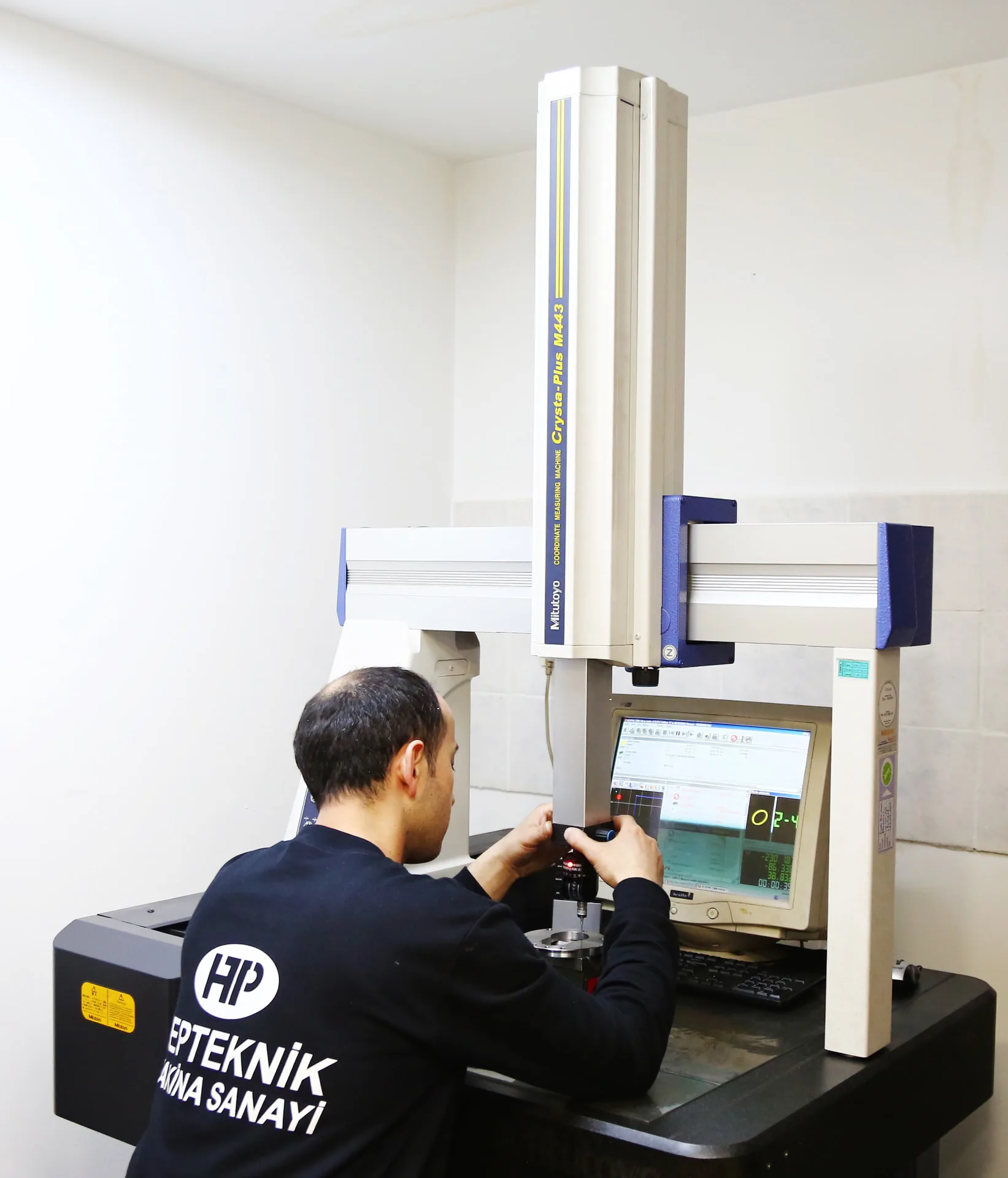
- Mitutoyo SJ-210 Surface Roughness Tester
- Mitutoyo CV-2100 Contour Measuring Device
- Mitutoyo PJ-A3000 Profile Projector
- Mitutoyo Quick Scope Camera Measurement System
- Mitutoyo CRYSTA-Apex V500 3D CMM

Send your drawing
Have a Swiss-Type Component to Source?
Send HEPTEKNIK your technical drawing, material, quantity and delivery requirements for review. Our engineering team confirms the process route and inspection needs before preparing a quotation.
Accepted upload formats: STEP, STP, IGES, IGS, DXF, DWG, PDF, ZIP, X_T and SLDPRT.
Applications
Industries and Applications
Swiss-type turned components may be manufactured for a range of industrial applications, subject to review of the customer's requirements:
- Hydraulics
- Automotive and mobility applications
- Industrial machinery
- Construction and agricultural equipment
- Defense and aerospace applications where customer requirements can be met
Applicability is assessed per project; sector-specific approvals are reviewed with the customer before any commitment.
Why HEPTEKNIK
Why Work With HEPTEKNIK?
- Manufacturing experience since 1991
- Ø1–Ø32 mm Swiss-type machining capability on 8 sliding-head CNC machines
- Components up to 300 mm, with live tooling and sub-spindle capability
- Prototype, batch and serial production from the same drawing-based process
- In-house dimensional inspection with CMM / 3D measurement
- ISO 9001, ISO 14001 and ISO 45001 management systems
- Istanbul-based, export-oriented manufacturing in İkitelli Organized Industrial Zone
FAQ
Frequently Asked Questions
- What is Swiss-type or sliding-head CNC machining?
- In Swiss-type (sliding-head) CNC machining, bar stock is fed through a guide bushing so the workpiece is supported very close to the cutting tool. The short unsupported length makes the process well suited to small-diameter, long and slender precision turned components. HEPTEKNIK operates Swiss-type sliding-head CNC machines at its facility in the İkitelli Organized Industrial Zone, Istanbul, Türkiye, and has been manufacturing machined components since 1991.
- What diameter range can HEPTEKNIK machine on its Swiss-type CNC equipment?
- HEPTEKNIK's Swiss-type machining capability covers the Ø1–Ø32 mm diameter range on 8 Swiss-type CNC machines, for components up to 300 mm in length. Final suitability for a specific part depends on the drawing, component length, material, tolerances and any secondary operations.
- What materials can HEPTEKNIK machine on its Swiss-type machines?
- Commonly machined material families include stainless steels, free-cutting steels, carbon steels, alloy steels, aluminium alloys, brass, and copper and copper alloys. Final manufacturability depends on the material grade, geometry, tolerance requirements and production quantity stated in the customer specification.
- When should a buyer choose Swiss-type machining instead of conventional CNC turning?
- Swiss-type machining is generally the better route for smaller diameters within the Ø1–Ø32 mm range, for long or slender geometries, for bar-fed production and for repeat production of components that need several operations in the same machining sequence. Larger diameters and chucked components are planned on our conventional CNC turning centres. If the correct route is unclear, send the drawing and our engineering team will confirm it.
- Can HEPTEKNIK produce prototypes as well as serial quantities?
- Yes. HEPTEKNIK supports prototype and sample production, batch production and serial production. Each RFQ is reviewed according to the drawing, material, quantity and manufacturing requirements before a quotation is prepared.
- Can international buyers send STEP or PDF drawings for quotation?
- Yes. Drawings can be uploaded directly through our request-a-quote page in STEP, STP, IGES, IGS, DXF, DWG, PDF, ZIP, X_T and SLDPRT formats, together with the material specification, required quantity and delivery expectations.
- Do your Swiss-type machines have live tooling and sub-spindle capability?
- Yes. Live-tooling and sub-spindle capability can support multi-operation machining and reduce additional handling for suitable component geometries. Final process planning remains drawing-dependent and is confirmed during manufacturability review.
Request a quotation
Request a Quotation
Send your technical drawing, material specification, required quantity and delivery expectations. HEPTEKNIK will review the part geometry, manufacturing requirements and inspection needs before preparing a quotation.
